T-Bill slump raises rising borrowing costs concerns

Treasury bills
A sharp decline in investor demand for Treasury bills is raising fresh concerns about government financing and borrowing costs, even as broader segments of the financial market show mixed performance.
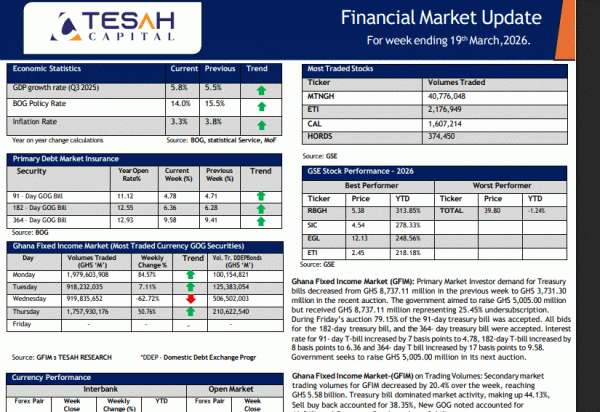
Data from the Ghana Fixed Income Market indicate that investor appetite for Treasury bills dropped significantly in the latest auction, with total bids falling from GH¢8.74 billion in the previous week to GH¢3.73 billion.
This decline comes at a time when the government is targeting GH¢5.01 billion in its next auction, signalling potential challenges in meeting short-term financing needs.
Despite the dip in demand, the previous auction recorded an oversubscription of 25.45 percent, as total bids of GH¢8.74 billion exceeded the government’s target.
However, the weakening momentum in subsequent demand suggests growing caution among investors, likely influenced by interest rate movements and broader macroeconomic conditions.
The implications for government are significant. Reduced demand for Treasury bills typically forces the state to offer higher yields to attract investors, increasing the cost of borrowing and potentially widening fiscal pressures.
This trend was already evident in the latest auction results, where yields rose across all tenors.
The 91-day Treasury bill rate increased by 7 basis points to 4.78%, the 182-day bill rose by 8 basis points to 6.36%, while the 364-day instrument recorded the sharpest increase of 17 basis points to 9.58%.
In terms of allocations, 79.15%of bids for the 91-day bill were accepted, while all bids submitted for the 182-day and 364-day instruments were taken up, reflecting the government’s effort to meet its financing requirements despite shifting investor preferences.
Activity on the secondary market also softened during the review period.
Trading volumes on the GFIM declined by 20.4% week-on-week to GH¢5.58 billion.
Treasury bills remained the dominant instrument, accounting for 44.13% of total trades, followed by sell-buy-back transactions at 38.35 percent.
New Government of Ghana notes made up 16.91%, while corporate bonds contributed a marginal 0.61%.
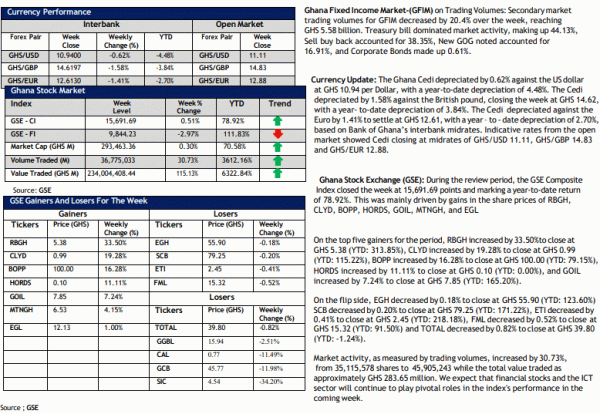
On the currency front, the Ghana cedi weakened against all major trading currencies, according to data from the Bank of Ghana. The cedi depreciated by 0.62% against the US dollar to close at GH¢10.94, bringing its year-to-date depreciation to 4.48%.
Against the British pound, the local currency declined by 1.58% to GH¢14.62, while it fell by 1.41% against the euro to settle at GH¢12.61.
Open market indicative rates showed the cedi trading at GH¢11.11 to the dollar, GH¢14.83 to the pound and GH¢12.88 to the euro, underscoring persistent pressures in the foreign exchange market.
In contrast, the equities market delivered a strong performance. The Ghana Stock Exchange Composite Index closed the week at 15,691.69 points, representing an impressive year-to-date return of 78.92%.
The rally was largely driven by gains in key stocks, including RBGH, CLYD, BOPP, HORDS, GOIL, MTNGH and EGL.
Among the top performers, RBGH surged by 33.50% to GH¢5.38, bringing its year-to-date gain to 313.85%.
CLYD rose by 19.28% to GH¢0.99, while BOPP climbed 16.28% to GH¢100.
HORDS advanced by 11.11% to GH¢0.10, and GOIL gained 7.24% to close at GH¢7.85, reflecting continued investor interest in select equities.
However, some stocks recorded marginal losses.
EGH dipped by 0.18% to GH¢55.90, SCB declined by 0.20% to GH¢79.25, while ETI, FML and TOTAL also posted slight decreases.
Market activity remained robust, with trading volumes increasing by 30.73% from 35.12 million shares to 45.91 million shares.
Total value traded stood at approximately GH¢283.65 million.
Joshua Adagbe, an analyst at Tesah Capital expect financial and ICT stocks to continue driving market performance in the near term, even as fixed income and currency markets face tightening liquidity and investor caution.
Overall, the mixed performance across Ghana’s financial markets highlights a delicate balancing act—strong equity gains on one hand, but weakening fixed income demand and currency pressures on the other—posing both opportunities and challenges for policymakers and investors alike.