Gold Fields Ghana’s community investment hits US$109.92m
Gold Fields Ghana’s community investment
The Gold Fields Ghana Foundation (GFGF) has cemented its role as a leading corporate driver of socio-economic development in the Western Region, with total investments in host communities rising to US$109.92 million over the past two decades.
The foundation’s contributions span key sectors including infrastructure, education, health, water and sanitation, agriculture, and community development, demonstrating a long-term commitment to improving the livelihoods of residents surrounding the Tarkwa and Damang mines.
According to the Foundation’s recent publication under its “Publish What You Spend” initiative, designed to enhance transparency and accountability, investments between 2004 and 2024 have been strategically deployed to meet the developmental needs of the host communities.
Sectoral breakdown
The sectoral breakdown of these investments is as follows: Infrastructure – US$74.91 million, Education – US$10.80 million, Enterprise Development – US$7.29 million, Health and Wellbeing – US$5.06 million, Training – US$4.88 million, Charitable Giving and Gifts-in-Kind – US$2.71 million, Conservation and Environment – US$2.57 million, Sports – US$1.59 million, and Arts and Culture – US$0.11 million.
Funding for the Foundation is sourced primarily from the Tarkwa and Damang mines, following a formula that links community development directly to mine productivity. For every ounce of gold produced, one US dollar is donated to the Foundation, alongside 1.5% of the mines’ pre-tax profits.
This innovative funding mechanism ensures sustainable financing for projects aligned with community priorities.
Since its inception in 2004, the Foundation has invested over US$104.3 million in targeted development programs.
The origins of the Foundation trace back to 2002, when Gold Fields Ghana established the Community Development Fund to support local initiatives.
Two years later, the fund was formalised as the Gold Fields Ghana Foundation, becoming the first mining company-led foundation in Ghana.
Its operations are guided by a formal governance structure, with a focus on five key areas: education, health, water and sanitation, agriculture, and infrastructure.
The Tarkwa mine, situated within the Tarkwa township approximately 317 kilometres west of Accra, impacts 11 communities under the Apinto Stool of the Wassa Fiase Traditional Area.

The Damang mine, located 30 kilometres northeast of Tarkwa, affects nine communities under the Bosomtwe, Damang, and Subri divisional stools.
Education and skills development
The Foundation has supported 2,448 students from host communities through scholarships and bursaries.
While the program initially covered vocational training, senior high school, and tertiary education, the implementation of Ghana’s Free Senior High School initiative refocused the scholarship on university and tertiary-level programs.
In addition, the Graduate Trainee Programme, launched in 2018, has enrolled 171 university graduates from host communities into a two-year structured, on-the-job training program across Mining, Engineering, Metallurgy, Finance, Human Resources, and Community Affairs. Informal apprenticeship schemes have also enabled youth to gain practical skills in dressmaking, auto mechanics, welding, and fabrication.
The mine-related training programme, initiated in 2016, has trained 191 young people in operating heavy mining equipment, with graduates receiving licenses for heavy equipment operation. Notably, six women from Tarkwa and five individuals from Damang have secured employment through this initiative.
To further support education, the Foundation introduced teacher motivation programs, including salary top-ups of 30–70% for select schools and the Best Teacher Awards instituted in 2016 and 2018 for Tarkwa and Damang, respectively, to recognise and incentivise excellence in teaching.
Health initiatives
The Foundation has prioritised health and well-being in host communities.
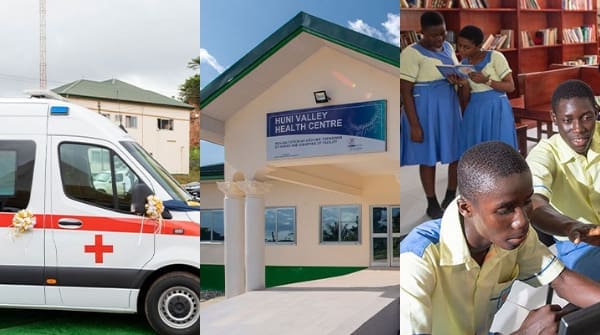
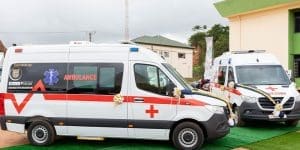
Since 2020, fully equipped ambulances have been donated to the Apinto Government Hospital, Tarkwa Municipal Hospital, and the University of Mines and Technology in Tarkwa, enhancing emergency healthcare and supporting the COVID-19 response.
Annual community health outreaches provide free medical screenings and medications, while awareness campaigns mark international health days such as World Malaria Day, World AIDS Day, and Breast Cancer Awareness Month.
For the past decade, the Foundation has sponsored the radio program “Bo Wo Ho Ban”, delivering essential health education to local audiences.
Water, sanitation, and environmental programmes
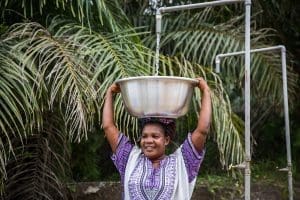
Over 150 water facilities—including hand-dug wells, boreholes, and small-town water systems—have been installed across 19 host communities.
More than 25 toilet facilities have also been constructed. To encourage proper hygiene and waste management, the Foundation initiated the Cleanest Community Awards in 2018, rewarding communities that maintain exemplary sanitation practices.
Agriculture and enterprise development
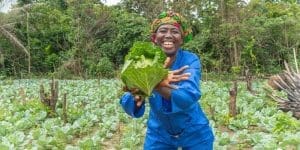
The Youth in Horticulture Production (YouHoP) program, launched in 2016 in partnership with GIZ, has trained 662 farmers in best practices for vegetable cultivation and marketing, with 60 farmers receiving Green Label Certification in 2020.
The Cocoa Farmers’ Support Programme, initiated in 2018, has benefited 600 farmers managing a total of 1,200 acres, with an observed 33% increase in cocoa yields for early participants. Rubber plantations have also been developed on rehabilitated mine lands, providing additional income streams for local farmers.
Infrastructure and community development
The Foundation has invested heavily in roads, bridges, and facilities.
The 33-kilometre Tarkwa-Damang road, rehabilitated at a cost of US$27.6 million in 2019, has improved transport, safety, and economic activity. More than 105 kilometres of additional roads have been constructed or rehabilitated, and several bridges have been built to improve connectivity.
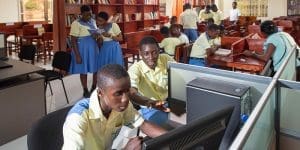
Education infrastructure has been enhanced with over 50 schools constructed or renovated, including libraries and ICT centres. Sixteen community centres have been established for social and recreational use.
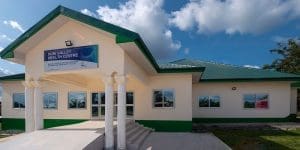
Nine clinics and health centres have been built or renovated, including the Huni-Valley Health Centre and maternity block at Apinto Government Hospital.
Sports infrastructure has also benefited, with the ongoing reconstruction of Tarkwa and Abosso Park into a stadium with a 10,400-seat capacity, poised to position Tarkwa as a football hub in the Western Region and serve as home ground for Medeama Sporting Club.
A lasting legacy
Over the past two decades, the Gold Fields Ghana Foundation has leveraged its resources to create lasting impacts across multiple dimensions of community life.
By aligning the developmental needs of the host communities with the operational success of the Tarkwa and Damang mines, GFGF has demonstrated a model of sustainable corporate social responsibility that continues to transform lives, foster skills development, and strengthen local economies in Ghana’s Western Region.