The German Ambassador to Ghana, H.E. Frederik Landshöft, has reaffirmed Germany’s commitment to deepening infrastructure cooperation with Ghana following a visit to the construction site of the Eastern Corridor Road, describing the project as a shining example of what the long-standing partnership between the two countries can achieve.
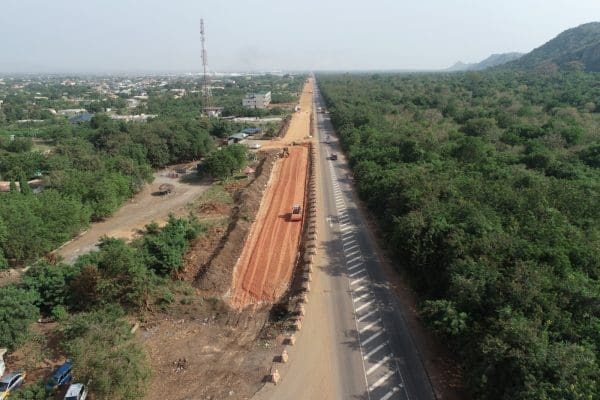
Ambassador Landshöft toured the 64-kilometre stretch of the Eastern Corridor Road (Lot 1) from Tema to Akosombo on February 13, 2026, and inspected the project’s main operational camp near Afienya.

The road is being constructed by German engineering firm INZAG and is backed by Germany’s export credit agency Euler Hermes through a loan facility exceeding €220 million.
The large-scale infrastructure project forms part of Ghana’s broader efforts to modernise its transport network and strengthen connectivity between the Port of Tema and the northern parts of the country.
With a total investment value of more than €250 million, the road is expected to improve trade flows significantly, reduce travel times, and stimulate economic growth across multiple regions.
Speaking during the visit, Ambassador Landshöft described the project as emblematic of the strength and depth of German-Ghanaian relations.
“This project stands for what a German-Ghanaian partnership can achieve. World-class infrastructure. Real opportunities for people. Renewed momentum for Ghana’s economic future. Germany and INZAG are ready for the next steps together with Ghana,” he said.
The Ambassador’s inspection provided him with first-hand insight into the technical sophistication and quality assurance mechanisms underpinning the project.
On site, state-of-the-art laboratories are being used to test construction materials to ensure durability and compliance with global engineering benchmarks.
Modern construction techniques are being deployed, while dedicated pedestrian walkways and enhanced safety infrastructure have been incorporated into the design to align with international best practices.
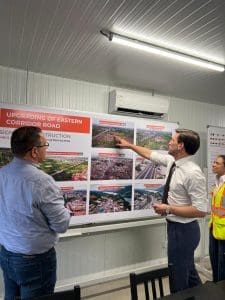
Project engineers explained that the road is being built to meet the highest international engineering standards, with durability and long-term sustainability at the core of its design philosophy. Once completed, it is expected to serve as a strategic transport artery, strengthening the logistical chain between the Port of Tema and landlocked northern Ghana for decades to come.
Beyond its physical infrastructure impact, Ambassador Landshöft highlighted the project’s significant social and human capital dimensions.
According to project officials, approximately 450 workers are currently engaged on site, with women accounting for nearly one-third of the workforce — a remarkable achievement in a sector traditionally dominated by men.
Women involved in the project occupy diverse roles, including welding, heavy machinery operation, technical supervision, and positions within project leadership.
The initiative’s targeted training and employment programmes are aimed at building local capacity, enhancing skills development, and promoting inclusion in Ghana’s construction and engineering sectors.
“This contributes meaningfully to skills development, inclusion and economic opportunity in Ghana,” the Ambassador noted, underscoring the broader development value embedded in the project.
The visit comes at a pivotal moment for the Eastern Corridor Road initiative.
Construction had experienced a period of near standstill during Ghana’s engagement under an International Monetary Fund programme, as debt restructuring negotiations affected the pace of externally financed projects.
However, momentum has been restored following the signing of a bilateral debt restructuring agreement between Ghana and Germany in November 2025.
The agreement fulfilled key conditions necessary for construction works to resume at full scale, clearing the way for renewed activity on the ground.
Ambassador Landshöft expressed optimism about the next phase of the project, indicating that a full resumption of works would significantly boost employment and accelerate delivery timelines.
“The full resumption of the project would allow the workforce to grow from around 450 to up to 900 people. Construction progress could accelerate up to threefold. This would deliver faster connectivity, more jobs and tangible economic momentum for Ghana,” he stated.
The anticipated expansion of the workforce would not only create additional employment opportunities but also deepen the transfer of technical knowledge and expertise to Ghanaian workers. Project managers say the scaling up of operations would shorten delivery timelines and ensure that the economic benefits of improved connectivity are realised sooner.
The Eastern Corridor Road is widely regarded as a critical national asset with the potential to reshape regional trade dynamics.
By enhancing the movement of goods and people between the Port of Tema and northern Ghana, the road is expected to lower transportation costs, improve access to markets for farmers and businesses, and attract investment along the corridor.
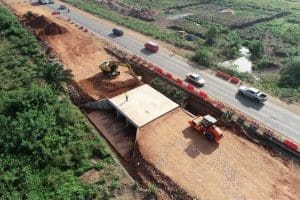
Improved road infrastructure is also expected to ease congestion on existing routes, improve road safety, and strengthen Ghana’s competitiveness as a trade and transit hub within West Africa.
Ambassador Landshöft took the opportunity to commend the Government of Ghana for its collaboration and commitment to advancing the project despite macroeconomic headwinds.
“I thank the Government of Ghana, especially the Ministry of Roads and Highways and the Ministry of Finance, for their close and constructive cooperation in advancing this important project,” he said.
The visit underscores the enduring partnership between Ghana and Germany, particularly in the areas of sustainable infrastructure, industrial development and economic cooperation. Over the years, Germany has supported Ghana through development finance, technical cooperation and private sector partnerships aimed at fostering inclusive growth and long-term resilience.
For Ghana, the successful delivery of the Eastern Corridor Road represents not only a major infrastructure milestone but also a signal of renewed investor confidence following its debt restructuring efforts.
For Germany, it reinforces its role as a reliable development partner committed to supporting Ghana’s long-term transformation agenda.
As construction regains full momentum, both countries appear poised to deepen cooperation, with the Eastern Corridor Road serving as a flagship symbol of shared ambition — world-class infrastructure built on partnership, inclusion and a commitment to sustainable economic progress.