Ghana to end raw mineral exports by 2030 – Mahama
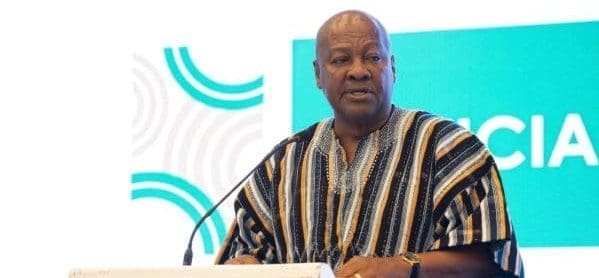
President John Mahama
President John Dramani Mahama has unveiled an ambitious minerals policy that will end the export of raw mineral ores from Ghana by 2030, declaring a decisive break from the country’s long-standing dependence on shipping unprocessed resources abroad.
Speaking at his high-level side event, “Accra Reset’s Addis Reckoning,” on the sidelines of the 39th African Union (AU) Assembly of Heads of State in Addis Ababa on Saturday, February 14, President Mahama announced that Ghana would no longer permit raw manganese, bauxite, iron ore and other mineral ores to leave its shores without local processing.
“By 2030, there won’t be any raw mineral ores leaving Ghana,” he declared.
“You’re not going to ship raw manganese ore out of Ghana. You’re not going to ship raw bauxite ore out of Ghana. You’re not going to ship raw iron ore out of Ghana. You must process all that locally.”
The 2030 deadline marks one of the most definitive timelines yet set by a Ghanaian leader on mineral beneficiation and signals a major structural shift in the extractive sector.
For decades, Ghana’s mining industry has largely revolved around the extraction and export of raw materials, with limited domestic value addition.
Under the new policy direction, the government intends to prioritise investment in local processing plants for strategic minerals, expand beneficiation capacity and develop integrated value chains.
The reforms are expected to accelerate plans for iron and steel production, aluminium processing and broader industrial development.
President Mahama argued that Ghana’s mineral wealth must serve as a foundation for job creation, industrial growth and technological advancement rather than feeding foreign processing industries.
“That is the only way we can provide opportunities for our young people,” he said, linking mineral beneficiation directly to tackling youth unemployment and strengthening economic stability.
The President situated the reforms within his broader “Accra Reset” agenda, which calls for African nations to assert greater control over their natural resources and restructure economic relationships that have historically favoured the export of raw commodities.
He stressed that value addition is no longer optional but urgent, warning that continued delays in industrial reform risk deepening Africa’s economic vulnerabilities.
“We come with the decisions. We agree. We do the frameworks. What is missing is urgency and implementation,” he said.
To fast-track progress, President Mahama proposed that countries ready to adopt aggressive beneficiation policies should form a “coalition of the willing,” enabling faster implementation while allowing others to join over time.
If fully implemented, the 2030 policy would transform Ghana from a predominantly extraction-based economy into a regional processing and industrial hub in West Africa.
BoA
Beyond mineral policy, President Mahama also used the AU Summit to call for a unified African position on the legacy of slavery and racialised chattel enslavement, which he described as “the gravest crime against humanity.”
At a press conference on Sunday, February 15, he emphasised that slavery is prohibited under international law as a peremptory norm from which no derogation is permitted.
He explained that Ghana’s proposed AU resolution on the issue rests on three pillars: historical accuracy, legal defensibility, and continental and diaspora alignment.
“Our approach ensures that the text of this resolution reflects rigorous scholarship, moral clarity, and diplomatic credibility,” he said, noting that Ghana had undertaken extensive consultations to strengthen the proposal.
These consultations involved UNESCO, the Global Group of Experts on Reparations, the Pan-African Lawyers Union, academic institutions, the AU Committee of Experts on Reparations and the AU Legal Experts Reference Group.
Push for gender equality and reform
As AU Champion for Gender Development Issues and Financial Institutions, President Mahama also reaffirmed his commitment to advancing gender equality across the continent.
Speaking at a High-Level Breakfast Meeting on Financing and Reaffirming Africa’s Gender Commitments, he urged member states to sign and ratify the African Union Convention on Ending Violence Against Women and Girls, a legally binding treaty adopted in February 2025.
“Ghana has signed the convention and this session of our Parliament is going to ratify it,” he said, calling on all member states to do so before the end of 2026.
He described violence against women and girls as not only a moral outrage but an economic catastrophe costing Africa billions annually in healthcare, lost productivity and justice expenditures.
President Mahama highlighted Ghana’s domestic efforts, including the enactment of the Affirmative Action Gender Equity Act, which sets binding targets for women’s representation — 30 per cent by 2026, 35 per cent by 2028 and 50 per cent by 2030.
He also announced that GH¢401 million has been allocated in the 2026 budget to capitalise a Women’s Development Bank aimed at expanding affordable credit and enterprise support for women, particularly those in informal and vulnerable employment.
In addition, he cited strengthened domestic violence units, specialised courts, social protection programmes such as LEAP and the School Feeding Programme, free sanitary pads for schoolgirls and free tertiary education for persons with disabilities.
President Mahama expressed confidence that Ghana’s political evolution would continue to expand opportunities for women, noting the historic election of the country’s first female Vice President and increased representation of women across government institutions and the judiciary.