
BoG explains gold sales as strategic reserve rebalancing
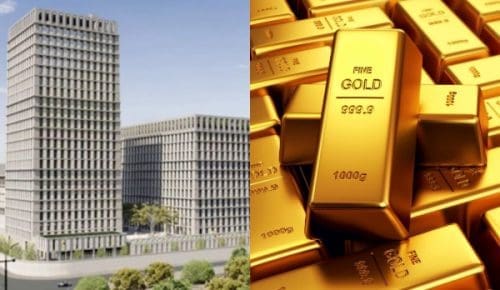
BoG head office and gold
The Bank of Ghana’s sale of 19.44 metric tonnes of gold reserves was driven by a deliberate strategy to diversify its reserve portfolio and to establish what it considers optimal levels for gold holdings within Ghana’s international reserves.
The decision, which reduced total gold holdings from about 38.4 metric tonnes in October 2025 to 18.6 metric tonnes by the end of December, represents a major recalibration of reserve management policy rather than a retreat from gold as a strategic asset.
Sources within the central bank explain that the move followed extensive internal assessments and benchmarking against international best practices.
While the BoG explored alternative risk-management options, including hedging part of its gold holdings, the final decision to sell was informed by cost, liquidity considerations and the need to rebalance reserves in line with peer central banks.
Why diversification became necessary
By October 2025, Ghana’s gold holdings had climbed to record levels, accounting for a much larger share of total reserves than is typical among comparable economies.
While this accumulation strengthened confidence in the cedi and reduced over-reliance on foreign currencies, it also created concentration risk.
Holding too large a proportion of reserves in a single asset, even one as historically reliable as gold, can limit flexibility when immediate foreign exchange liquidity is required.
According to sources, the Bank of Ghana became increasingly concerned that gold’s growing dominance within the reserve portfolio could constrain its ability to respond quickly to balance-of-payments pressures, external shocks or short-term currency volatility.
Diversification, therefore, became necessary to restore balance between gold and other reserve assets such as major foreign currencies.
Hedging considered but ruled out
Before opting for outright sales, the central bank reportedly contemplated hedging part of its gold reserves.
Hedging would have allowed the Bank of Ghana to retain ownership of the gold while protecting its value against adverse price movements.
However, internal analysis showed that hedging around 30% of the gold stock—the minimum level that would meaningfully manage price risk—would have been prohibitively expensive.
The costs associated with hedging, including premiums, margin requirements and the operational complexity of managing long-term hedge positions in volatile global markets, outweighed the perceived benefits.
As a result, the central bank concluded that selling part of the gold stock was a more practical and cost-effective way to rebalance reserves and meet its broader policy objectives.
Benchmarking against peer countries
Information picked up by newscenta.com indicates that the Bank of Ghana paid close attention to international best practices before executing the sales.
A review of reserve structures among Ghana’s peer countries revealed that most of them typically hold between 20% and 25 per cent of their reserves in gold, with the remainder diversified across foreign currencies and other assets.
This comparative analysis showed that Ghana’s gold holdings, which had risen well above this range by late 2025, were unusually high.
The findings reinforced the view that a reduction was necessary to align the country’s reserve composition with global norms and reduce exposure to asset concentration risk.
Timing ahead of the gold price rally
The decision to diversify gold holdings was taken before the recent surge in global gold prices, which followed escalating geopolitical tensions after the United States invaded Venezuela and tensions with Iran intensified.
These developments triggered a global rush into safe-haven assets, pushing gold prices to historic highs.
Sources within the Bank of Ghana stress that these geopolitical shocks and the scale of the subsequent rally could not have been foreseen.
The sales were therefore not an attempt to pre-empt a price peak or speculate on future market movements, but rather the implementation of a structural reserve-management decision that happened to precede an extraordinary shift in global conditions.
Expected inflows that did not materialise
Further context to the year-end figures lies in expectations around domestic gold inflows.
The central bank had anticipated additional deliveries of about two metric tonnes of gold from mining firms before the end of 2025.
Had these deliveries materialised, gold holdings would have remained above the 20% threshold considered optimal under the Bank’s internal benchmarks.
However, mining firms were unable to deliver the expected quantities within the period, contributing to the sharper-than-anticipated decline in reported holdings.
Even so, sources note that the Bank of Ghana typically receives more than 11 metric tonnes of gold from mining firms each year, suggesting that the current lower level is not permanent.
Outlook for rebuilding gold reserves
Based on historical inflows, the Bank of Ghana expects gold holdings to recover organically over time.
Officials are confident that, barring major disruptions, annual receipts from mining firms will gradually rebuild the gold stock. Projections indicate that gold could once again account for more than 30% of total reserves before the end of 2026, even without an aggressive accumulation drive.
This outlook reinforces the argument that the 2025 sales were a tactical adjustment rather than a fundamental shift away from gold.
A sharp shift in reserve composition
BoG gold holdings declined sharply by the end of 2025, marking one of the most significant shifts in Ghana’s reserve composition in recent years.
The move has reignited debate about reserve management, liquidity needs and the evolving role of gold in the country’s macroeconomic stabilisation strategy.
According to the Bank of Ghana’s Summary of Economic and Financial Data as of December 2025, gold reserves stood at 18.6 metric tonnes at year-end.
This represents a steep fall from previous levels and a dramatic reversal from the accumulation drive that characterised much of 2024 and early 2025.
In monetary terms, the central bank valued this gold stock at US$2.68 billion, highlighting that bullion remains a crucial component of Ghana’s international reserves despite the decline in volume.
What 18.6 tonnes really represents
Gold reserves are typically reported in metric tonnes, but their true financial significance becomes clearer when expressed in ounces, the standard unit used in global bullion markets.
One metric tonne of gold is equivalent to 32,150.7 ounces.
On this basis, Ghana’s 18.6 metric tonnes translate into approximately 597,959 ounces of gold.
Market value versus book value
Using a gold price of US$5,000 per ounce, the market value of this stock would be about US$2.99 billion, higher than the Bank of Ghana’s book valuation of US$2.68 billion.
The difference likely reflects valuation methodologies, pricing dates and accounting conventions rather than any discrepancy in physical holdings.
Even at the official valuation, gold remains one of the most valuable single components of Ghana’s external assets, providing an important buffer during periods of currency volatility and balance-of-payments stress.
How the decline compares historically
The scale of the reduction becomes clearer when viewed against historical data.
At the end of December 2024, the Bank of Ghana held 30.53 metric tonnes of gold.
By the end of December 2025, holdings had fallen to 18.6 metric tonnes, representing a net decline of 11.93 tonnes within a single year.
The most dramatic change occurred in the final two months of 2025. As of October 31, holdings had reached a peak of 38.04 metric tonnes.
From that level, reserves fell by 19.44 tonnes by year-end, pointing to substantial sales over a relatively short period.
Active liquidation, multiple objectives
The pace and scale of the decline suggest an active liquidation of bullion rather than a gradual drawdown.
Analysts note that such a move could have served several objectives simultaneously, including boosting foreign exchange liquidity, supporting currency stability, rebalancing the reserve portfolio and monetising part of the gold stock during a period of elevated prices.
Gold’s evolving role in Ghana’s economy
Gold has long been a strategic buffer in Ghana’s macroeconomic framework.
The Bank of Ghana has consistently framed gold accumulation as a tool to diversify reserves, reduce dependence on foreign currencies and strengthen confidence in the cedi during periods of heightened volatility.
Unlike foreign currency assets, gold carries no default risk and is widely seen as a hedge against inflation, currency depreciation and geopolitical shocks.
The sharp reduction in holdings therefore underscores the difficult trade-offs central banks face between long-term reserve security and short-term liquidity needs.
In Ghana’s case, the 2025 sales reflect a pragmatic recalibration—one that seeks to balance the enduring value of gold with the practical demands of managing reserves in a volatile and uncertain global environment.