
The Asantehene, Otumfuo Osei Tutu II, has issued a strong call for the Bank of Ghana (BoG) to lead a deliberate national shift towards lower interest rates, insisting that Ghana’s economic recovery will remain incomplete if high borrowing costs continue to suffocate businesses, private sector investment and job creation.
He also appealed for the central bank to be firmly protected from political interference, describing its independence as essential to the country’s long-term stability and prosperity.

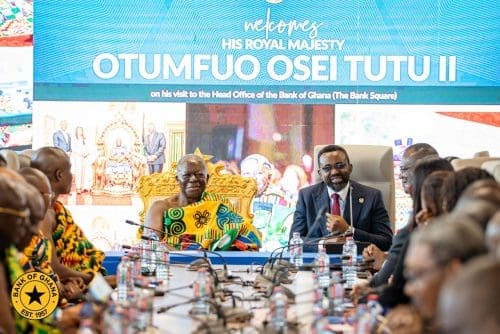
Addressing a special durbar at Bank Square, the new head office of (BoG) in Accra, the Asantehene said that while recent stability in the foreign exchange market was encouraging, it would mean little to ordinary Ghanaians and businesses if access to affordable credit remained elusive.

According to him, sustainable growth requires not only a stable currency but also an interest rate environment that actively stimulates domestic production, enterprise and wealth creation.
“At this moment, I call for a massive push to stimulate domestic and private investment for industries.
The time has come for us to do business, and not just talk,” Otumfuo Osei Tutu II declared.
“The challenge I leave with your creative brains is to fashion how you move the economy from the crippling, high-interest community to the level where it becomes a stimulant of business and wealth creation.”
A historic visit to bank square
The durbar was organised to formally welcome the Asantehene on his first-ever visit to the head office of the Bank of Ghana, a moment widely regarded as historic given the symbolic weight of traditional authority engaging directly with the nation’s central bank.
Otumfuo Osei Tutu II was accompanied by a distinguished delegation of chiefs and elders from Asanteman and was warmly received by the Governor of the Bank of Ghana, Dr Johnson Pandit Asiama, the First Deputy Governor, Dr Zakari Mumuni, the Second Deputy Governor, Matilda Asante-Asiedu, members of the board of directors, management and heads of departments and offices.

As part of the visit, the Asantehene toured the offices and facilities at Bank Square, gaining firsthand insight into the operations of the central bank and the infrastructure supporting its policy, research and regulatory functions.
He described the new headquarters as a powerful monument of national confidence and institutional renewal, stressing that it should inspire a higher level of professionalism, efficiency and accountability among staff.
“This building is not just an edifice of concrete and glass; it is a symbol of the authority, responsibility and enduring mandate of the Bank of Ghana,” he said.
“It symbolises the resilience of this institution and its readiness to confront complex monetary and financial challenges.He expressed confidence that the modern infrastructure would strengthen policy coordination, deepen research capacity and enhance decision-making in support of macroeconomic stability and national development.
Guarding the integrity of the central bank
Beyond the physical structure, the Asantehene used the occasion to make a passionate appeal for the protection of the Bank of Ghana’s independence.
He warned that excessive political interference could undermine the credibility and effectiveness of the central bank, with serious consequences for the economy and the welfare of citizens.
“This is a unique institution with a mandate that ultimately affects every citizen of the land. Ideally, this citadel should be a fortress insulated from the strings and arrows of the political warfare,” he said. “Whatever it is, we should think twice before we do anything that has the capacity to cast a snare on the integrity of the bank.”
Otumfuo Osei Tutu II commended the Governor, management and staff of the Bank of Ghana for their expertise, resilience and commitment to duty, particularly under the intense pressures of recent economic challenges.
He called on political actors across the divide, as well as the broader public, to show restraint, mutual respect and support for the central bank as it carries out its constitutional mandate.
“I will appeal to the nation and both sides of the political divide to give the Governor, my son, and his team a chance; give them the space and respect to perform their professional duties,” he said. “This is our bank; if they fail, we risk collapse; if they succeed, we walk in wealth and in glory.”
The Asantehene also stressed that macroeconomic stability must ultimately translate into tangible benefits for the youth, urging policymakers to prioritise youth-focused policies that convert stability into jobs, entrepreneurship and enterprise opportunities.

He advocated governance and economic strategies that strengthen private sector growth, social cohesion and inclusive national development.
BoG outlines progress and discipline
For his part, the Governor of BoG, Dr Johnson Pandit Asiama, described the Asantehene’s visit as both timely and significant, noting that the country had often benefited from Otumfuo Osei Tutu II’s moral authority and steady leadership during moments of national tension.
He recalled a previous engagement at the Manhyia Palace where the Asantehene had questioned whether the cedi’s appreciation against the US dollar at the time was sustainable, a concern that resonated deeply with many Ghanaians.
According to Dr Asiama, that question went beyond short-term exchange rate movements to the deeper issue of credibility in economic management.
He said Ghana’s economic recovery was now gradually taking shape, underpinned by sustained discipline and deliberate policy choices.
Inflation, which stood at 23.8% in December 2024, had declined significantly to single digits in 2025, driven by tight monetary policy, improved food supply conditions and closer coordination between the Bank of Ghana and the Ministry of Finance.
“These outcomes are not accidental; they reflect deliberate policy choices and a firm commitment to stability,” the Governor stated.
Path towards lower interest rates
Dr Asiama explained that the easing of inflationary pressures had allowed the central bank to carefully recalibrate its policy stance, reducing the monetary policy rate from 27% to 18% in order to support credit growth while preserving hard-won gains in stability.
He expressed optimism that lending rates could decline further over the medium term, revealing his personal aspiration to see lending rates fall to about 1% by the end of his tenure.
On the external front, the Governor disclosed that Ghana’s gross international reserves had risen to about $13.8 billion, providing close to six months of import cover, a level he described as historic.
He added that the cedi ended the year among Africa’s strongest-performing currencies, supported by stronger reserves, lower inflation and restored policy credibility.
However, he cautioned against complacency, stressing that exchange rate stability must be earned continuously through competitiveness in the real economy rather than treated as a permanent achievement.
“We see this performance not as a victory lap, but as a responsibility,” he said.
Dr Asiama reaffirmed the Bank of Ghana’s commitment to independence, professionalism and transparency, emphasising that the ultimate objective was to translate improved macroeconomic indicators into jobs, stronger local industries and better livelihoods for Ghanaians.
Deepening engagement for national development
The Asantehene’s visit formed part of a broader tour aimed at deepening engagement with key national institutions and gaining a clearer appreciation of their roles in national development.
He underscored the importance of a stable financial system to Ghana’s progress and commended the Bank of Ghana for its efforts in managing inflation, regulating the banking sector and supporting economic recovery.
“When the currency is healthy, the economy bristles with opportunities, the people are able to use the opportunities to create business, the business allows the people to create jobs, and ultimately walk in wealth,” he said.
The visit included interactions with management and staff of the Bank, as well as briefings on the central bank’s core functions, policy direction and ongoing reforms aimed at strengthening the resilience of Ghana’s financial system.
It also highlighted the value of continuous dialogue between traditional authorities and state institutions in promoting inclusive growth, stability and long-term national confidence.
In both symbolism and substance, the Asantehene’s presence at Bank Square reinforced a powerful message: that Ghana’s path to prosperity depends not only on stable currencies and impressive buildings, but on disciplined policy, lower interest rates that unlock enterprise, and a fiercely protected central bank that serves the national interest above all else.