
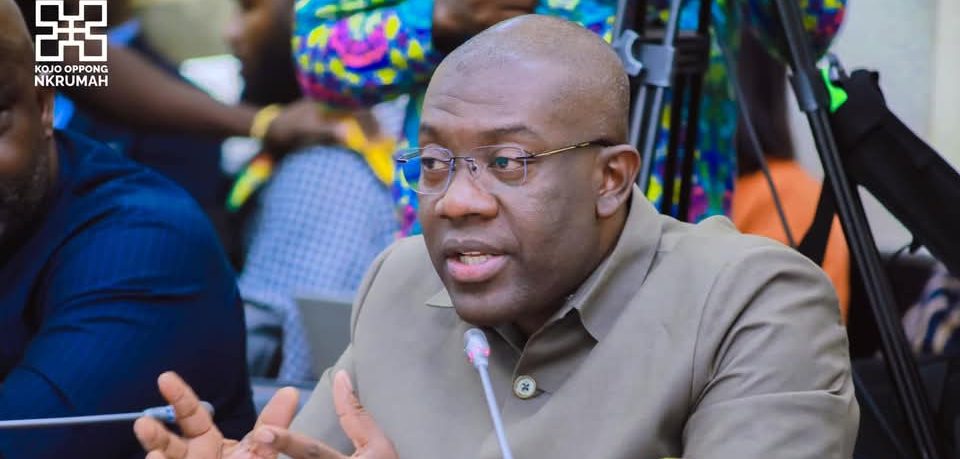
The Minority Caucus in Parliament has issued an urgent national address, expressing deep concern over what it called a “Golden Betrayal” involving GoldBod and the Bank of Ghana. It warned that Ghana’s economy, environment, and future generations are at serious risk.
Speaking to the media during the Christmas season, the Minority said it had suspended its holidays to alert the nation to what it described as a deepening crisis of economic sabotage, environmental degradation, and institutional capture linked to the country’s gold trading framework.


According to the Minority Caucus, Ghana could lose as much as $300 million in 2025 due to the operations of GoldBod, with an IMF report already citing $214 million in losses within the first nine months. It stressed that these figures represent only part of the damage, cautioning that focusing solely on the Bank of Ghana risks overlooking wider structural failures in the system.
Questions over a gold monopoly
Central to the Minority’s concerns is Bawa-Rock Limited, owned by Alhaji Bawa, which it claims has become the sole licensed aggregator allowed to purchase artisanal gold on behalf of GoldBod nationwide.
The Minority questioned why a de facto monopoly was created in a sector that traditionally relies on competition to ensure transparency and fair pricing. It demanded answers on how Bawa-Rock was selected, who its beneficial owners are, and why miners and dealers must route gold through a single private entity before it reaches GoldBod and the Bank of Ghana.
“Until these questions are answered publicly, no Ghanaian can trust the integrity of this scheme,” the Minority stated.
How the losses occur
The Caucus explained that losses arise from the programme’s structure. While GoldBod reportedly pays miners at near-global market prices and prevailing forex bureau rates, it later sells the foreign currency to the Bank of Ghana at weaker interbank rates. The resulting exchange-rate gap, the Minority said, is absorbed by the central bank.
“This is not market fluctuation,” the statement argued. “It is a system designed for the state to bleed while intermediaries remain protected.”
From reserves to trading
The Minority contrasted the current situation with the original Gold-for-Reserves programme, under which Ghana’s gold reserves reportedly grew from 8.7 tonnes to 31 tonnes within two years without losses, as the Bank of Ghana directly acquired gold for strategic reserves.
Under the current administration, GoldBod now functions more like a trading company than a reserves-building institution. Despite large volumes of gold transactions, national reserves have increased by only seven tonnes, from 31 to 38 tonnes—a development the Minority described as evidence of “rent-seeking” rather than sound economic policy.
Social and environmental cost
Beyond financial losses, the Minority highlighted the human and environmental cost. It noted that $214 million could have funded dozens of hospitals, tens of thousands of boreholes, and critical social infrastructure.
The Caucus also warned that illegal mining continues, with forests destroyed, rivers polluted, and cocoa farms lost. It accused GoldBod of failing to meet international traceability standards, raising fears that state-backed gold purchases may inadvertently include proceeds from illegal mining.
Demands for accountability
Rejecting official denial, the Minority pointed to IMF assessments that classify the operations of GoldBod as a significant risk to Ghana’s economic stabilisation programme. It outlined four key demands:
Establish a parliamentary ad-hoc investigative committee with subpoena powers to examine all contracts and intermediaries, including Bawa-Rock.
Full public disclosure of pricing formulas, fee structures, aggregator selection processes, and forex arrangements.
Emergency environmental measures, including suspending mining permits in forest reserves and implementing mine-level traceability systems.
Full accountability, requiring the Governor of the Bank of Ghana and the CEO of GoldBod to appear before Parliament, with prosecutions and asset recovery where wrongdoing is proven.
A National call
The Minority stressed that the issue transcends party politics, framing it as a test of whether Ghana still has guardians of the national interest. It called on traditional leaders, religious bodies, civil society, students, and the diaspora to demand transparency and action.
“Gold may glitter, but truth endures,” the statement concluded, urging citizens to rise, question, and defend Ghana’s patrimony during the Christmas season.