
Margins@35: A $100 idea is now Africa’s most certified identity powerhouse
By any global measure, Margins ID Group today sits in rare company. It is Africa’s most certified secure production facility for intelligent cards and security products.
It is the first African firm to manufacture a secure national identity card on African soil.
It is also the first African company to serve as a prime contractor for a national ID project anywhere on the continent.
Its systems now underpin some of Ghana’s most critical national platforms, from identity management and border control to vehicle registration and insurance claims.
And beyond Ghana, its footprint stretches across eight countries, with operations and subsidiaries in Europe, North America and West Africa.
Yet for Moses Kwesi Baiden Jnr., Founder and Chief Executive Officer (CEO)of Margins ID Group, these achievements are not trophies to be admired from a distance.
They are proof of something deeper: that Africans can build world-class, high-security, technology-intensive industries at home, if belief, discipline and patience replace doubt and shortcuts.
After 35 years, Margins’ journey reads less like a corporate biography and more like a long argument against the idea that complex, high-value manufacturing and digital systems cannot be done in Africa.
Certified to compete with the world
In the highly regulated world of secure identity, trust is everything.
Governments do not take chances with systems that define citizenship, control borders, protect elections and secure financial transactions.
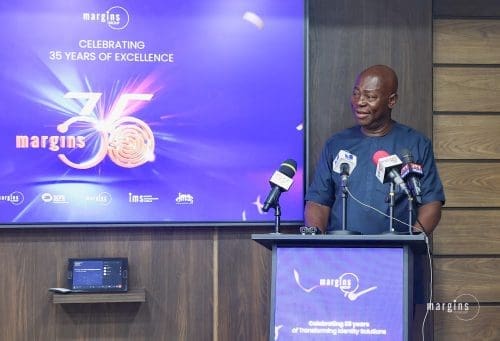
Sharing this inspirational story with senior media practitioners in Accra to as part of activities marking the 35 anniversary, Mr Baiden said that reality shaped Margins’ philosophy from the start.
“When you come from the wrong neighbourhood,” he often said, “people assume you are incompetent until you prove otherwise.”
He explained that this is why certifications became non-negotiable.
Not as marketing badges, but as independent validation of systems, processes and discipline.
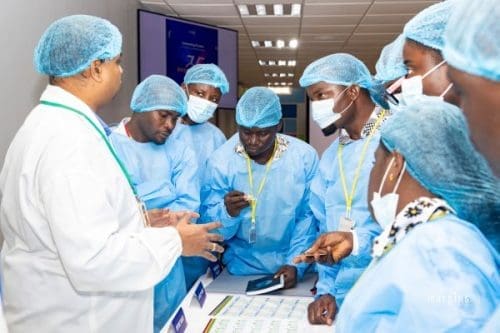
Today, Margins operates one of the most comprehensively certified secure facilities on the continent.
Certifications secured
Margins ID Group has earned a suite of internationally recognised certifications, including ISO 27001:2022 for Information Security Management Systems, ISO 22301:2019 for Business Continuity Management Systems, ISO 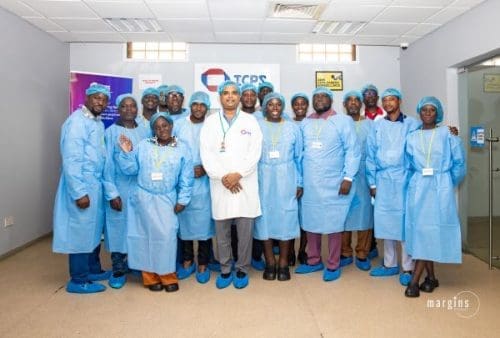 20000:2018 for Service Management Systems, as well as Integraf certification.
In addition, the company holds both Cybersecurity Establishment and Cybersecurity Service Provider certifications.
These certifications, notoriously difficult and expensive to obtain, confirm compliance with global standards for security printing, intelligent card production, data protection, quality management and operational integrity.
“They matter because they show that you have world-class processes and systems, not just because you say so.
“They allow you to prove your pedigree and to run a business in a scientific, open, progressive, efficient and effective way,” Mr Baiden explained.
In a sector where a single weakness can compromise national security, Margins’ certifications have become its global passport, enabling it to compete credibly with long-established European and Asian firms.
More than just a card
To the untrained eye, identity appears deceptively simple: a card with a name, a photograph and a number. But Mr Baiden is quick to dismantle that illusion.
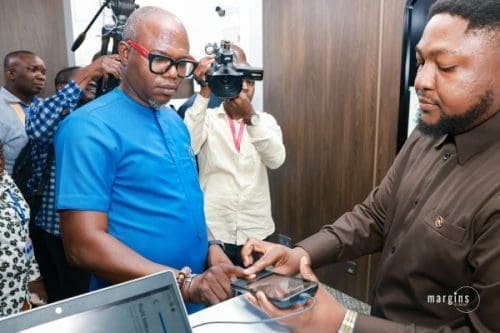
He explained that in the digital era, Margins has evolved from a manufacturing company into a full-scale solutions provider.
27 core competencies
Across its solutions companies, Margins has developed 27 core competencies.
For Ghana’s National Identification Authority (NIA) system alone, he said, there are 22 distinct subsystems, all delivered by Margins and its partners.
Mr Baiden noted that the single secure card involves more than 36 suppliers across materials, chips, inks, laminates and security features.
Margins designs the card, orchestrates the supply chain, integrates the technologies and produces it under tightly controlled conditions, he added.
He pointed out that beyond production, the company designs and deploys the entire ecosystem: hardware integration, stress and humidity testing, communication networks, data transfer and encryption, firewalls, cybersecurity monitoring, personalisation platforms, lifecycle management systems, inventory controls, issuance software and cryptographic modules.
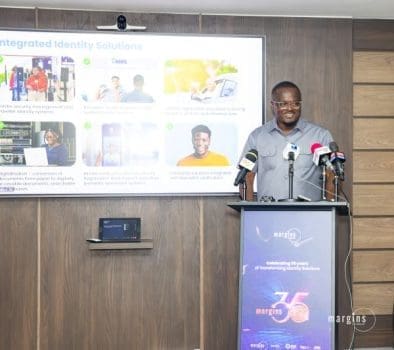
“This is not just printing. “Each subsystem requires very different expertise, and all of them must work together perfectly,” Mr Baiden insists.
According to him, it is this systems thinking that has made Margins indispensable to some of Ghana’s most critical national platforms.
The Ghana Card and a model for Africa
The Ghana Card has become Margins’ most visible product, though Mr Baiden is careful to emphasise partnership rather than ownership.
“The NIA is our partner. We support them. We do not replace them,” he said.
The results speak for themselves. Ghana has registered about 90% of its adult population, an achievement that places it among the most advanced national ID systems in the developing world.
In one year alone, 15.7 million people were registered, with production capacity reaching up to 250,000 cards per day.
Mr Baiden recalled visiting remote villages and watching NIA officers work under punishing conditions. “It is not perfect,” he admits, “but it is a fantastic job.”
In his view, the success of the Ghana Card lies not only in technology but in governance.
Sustained over more than 13 years, he opined that the NIA partnership represents one of Ghana’s most successful public-private partnerships, structured around transparency, compliance, goodwill and national interest.

A model for other countries
Many countries now want to replicate Ghana’s model. Delegations from across Africa regularly visit to study how identity in Ghana has been integrated into public services.
Beyond identity: Building national platforms
Margins’ work extends far beyond national IDs.
The company has built Ghana’s Driver and Vehicle Licensing Authority’s (DVLA) system, linking every registered vehicle and driver to the Ghana Card while maintaining an independent platform.
This integration has transformed law enforcement and road safety.
Margins has also delivered a national health insurance claims system with a secure data warehouse designed to eliminate forged claims.
The company has built systems to identify and remove ghost names from public payrolls, awaiting deployment by the Controller and Accountant General’s Department
It has delivered Ghana’s border control system, making Margins the only African company to have built such a platform locally.
Mr Baiden revealed that Many Ghanaians carry Margins’ products without knowing it.
The company manufactures Visa, Mastercard, UnionPay and European payment cards and builds personalisation systems used by banks, either in-branch or as a managed service.
Operating across continents
Today, Margins operates in eight countries, with companies in Portugal, Copenhagen, Silicon Valley and The Gambia.
It is already producing The Gambia’s national ID cards and is finalising additional major contracts there.
This global presence did not emerge overnight.
It is the result of three and a half decades of methodical expansion, strategic partnerships and relentless reinvestment.
A painful lesson in belief
Despite its achievements, Mr Baiden carries memories of moments that revealed how deeply entrenched doubt about African capability can be.
He recalled a meeting in Accra during the early days of Ghana’s national ID journey, where Margins and its partners were preparing to build what would become the first card production facility of its kind in sub-Saharan Africa.
The consortium included major blue-chip international firms, and Mr Baiden had taken on the role of CEO to prevent internal competition and present a united front.
His presentation excited many in the room, particularly European stakeholders. Then a government official raised her hand.
“She asked, ‘If we build this factory in Africa, would that not compromise security?’”
The room fell silent. Millions of dollars were being raised to build a world-class facility, yet the suggestion was that manufacturing in Africa itself was a security risk, he said.
“I have never forgotten that moment. It revealed a mindset,” Mr Baiden said.
For him, that mindset is the real obstacle to industrialisation. “When soil is fertile, seeds grow naturally. When the soil is hard, nothing grows. “We cannot industrialise, and we cannot build wealth without building things,” he reflects.
From boys’ quarters to boardrooms
The irony of that doubt is that Margins itself began in conditions far humbler than any sceptic could imagine.
The story starts in 1990, at the cusp of the ICT revolution. Computers were shrinking from room-sized machines into desktops and laptops.
Mr Baiden, then a law student in his early twenties, was captivated.
His first savings, earned from holiday work in London, went into a Toshiba laptop costing £3,500.
“That was all the money I had,” he recalls. “But I believed computers were going to change the world.”
Although his father wanted him to be a lawyer, Mr Baiden always wanted to be a businessman.
He went to law school, excelled academically and even became a teaching assistant, but business never left his mind. Watching his elder brother sell computers in London, he saw an opportunity.
At the time, computers were replacing typewriters. Printers were replacing carbon paper.
Mr Baiden asked a simple question: if computers were everywhere, who would supply what was needed to print, bind and preserve documents?
The answer became Margins. For every computer, there would be a printer; for every printer, paper; and for every paper, something to bind or laminate it.
With just $100, operating from the boys’ quarters at Ringway Estates, Mr Baiden started the business at 24.
He convinced his brother to give him his first binder and laminator, promising he could make a million dollars in 36 months.
Returning to Ghana while still in law school, he and his friends demonstrated products in offices across Accra.
Within 24 months, Margins had sold over 1,000 laminators and binders.
By 27, the company was already making millions from consumables, supported by an obsession with customer service.
Even in the early 1990s, Margins ran a fully networked office with inventory, invoicing and warehouse management systems, built with the help of Andrew, a mathematician and computer scientist from Imperial College London.
What would later be called CRM was already in place.

From Printing to Identity
As Margins grew, clients began to ask for services rather than machines.
This led to Print Solutions and, eventually, to ID card production. Identity printing required new knowledge: substrates, inks, lamination films and security features.
Peter Blom’s role
Mr Baiden was full of praise for his Danish partner Peter Blom who has been instrumental in the success story of Margins
Mentorship played a critical role. Mr Baiden’s father remained a guiding force, but another mentor emerged in Dr. Wolfensperger, a Swiss businessman who introduced him to global systems thinking.
Through him came a Korean mentor, Young Pioung Kim, who invited Mr Baiden into a global circle of CEOs and taught him manufacturing and security printing.
By 1997, Margins was laminating passports.
When Ghana adopted hot-melt laminated passports without local expertise, Mr Baiden flew to Korea, worked overnight with engineers to modify machines, returned to Ghana and demonstrated the solution. Margins won the contract.
From there, evolution was constant: bank cards, voter IDs, military and police IDs, airport systems and, eventually, national identity platforms.
“We changed as digitisation changed the form factor,” Mr Baiden said.
A vision for Africa
Early on, Mr Baiden recognised that identity would be central to Africa’s future.
With a projected population of 1.4 billion, the continent needed secure, integrated systems to connect people to services.
That vision led to partnerships with Danish and Brazilian firms and the creation of Margins ID Systems Limited.
Through innovation, grants and partnerships—not shortcuts—the company built high-tech manufacturing and software capacity in Africa.
“A factory is not just machines,” Mr Baiden insists. “It is knowledge, systems and a market.”
No shortcuts, just work
After 35 years, Baiden is clear about the cost of success. “I do not believe in get-rich-quick schemes,” he says. “I have worked 12 to 14 hours a day for 35 years.”
He is equally clear about credit. “I am only one man, supported by an extraordinary team.”
Much of Margins’ software is written in Ghana, by Ghanaian engineers, working alongside global talent.
For Baiden, Margins’ journey is not just a corporate success story. It is a challenge to a nation—and a continent—to believe in its own capacity.
“If we put our minds to it,” he says, “everything is possible.” After 35 years, Margins ID Group stands as living proof.
Chairman of the NIA Board, Moses Afetsi Positive, has openly expressed gratitude to Margins for the role it has played in helping the Authority build what he describes as a “very good system.”
In his assessment, the partnership has gone far beyond technology delivery to address one of Ghana’s most persistent governance challenges: waste.
According to him, the national identity system that Margins helped design and deploy has become one of the most effective tools available to the state to eliminate waste across public and private systems.
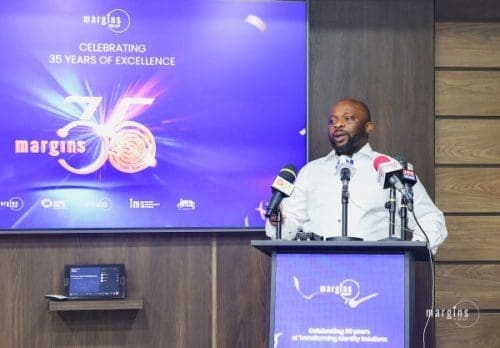
By providing a single, trusted source of identity, the Ghana Card has made it increasingly difficult for ghost names to survive in payrolls, databases and benefit schemes.
He also underscored its growing relevance in the fight against cyber fraud, noting that reliable identity is now the first line of defence in a digital economy.
Afetsi Positive believes the Ghana Card represents a national asset whose impact should be measured in long-term institutional efficiency rather than short-term political arguments.
He has therefore appealed to the media to focus attention on the progress Ghana is making through the national identity system, instead of reducing the conversation to partisan politics.
For him, the system is not about which government initiated it, but about what it enables the nation to achieve.
That sentiment is shared even more forcefully by the Executive Secretary of the NIA, Wisdom Yayra Koku Deku, who has been candid about the Authority’s early struggles and the decisive role played by the public-private partnership with Margins.
Without that partnership, Deku admits, the NIA might not have survived.
In the early stages of the national ID rollout, the Authority printed about two million cards but was able to distribute only around 900,000.
The gap exposed deep operational and logistical challenges that could easily have derailed the entire programme.
It was the systems, processes and sustained support embedded in the partnership with Margins that helped stabilise the project and place it on a sustainable footing.
Today, Deku said, the NIA is preparing to transition into a new phase, anchored in a revised legal framework.
When the new Act is passed next year, the Authority will be more deeply integrated into Ghana’s security architecture.
Under the new law, law enforcement agencies, including the police, will be able to access defined information linked to the Ghana Card, allowing them, at the point of use, to determine whether an individual has a criminal record or not.
This, he explains, will significantly enhance crime prevention, investigations and overall public safety, while operating within clearly defined legal safeguards.
He also reminded stakeholders that the foundation for the Ghana Card’s central role in national life was laid more than a decade ago.
A Legislative Instrument passed in 2012 made the Ghana Card mandatory for any transaction that requires identification.
What Margins and the NIA have since done, he argues, is to give practical, functional meaning to that law by building a system capable of supporting it at scale.
It has four subsidiaries namely Margins ID Systems Applications LTD, Intelligent Card Production Systems (ICPS) and Identity Management System (IMS I &II)