
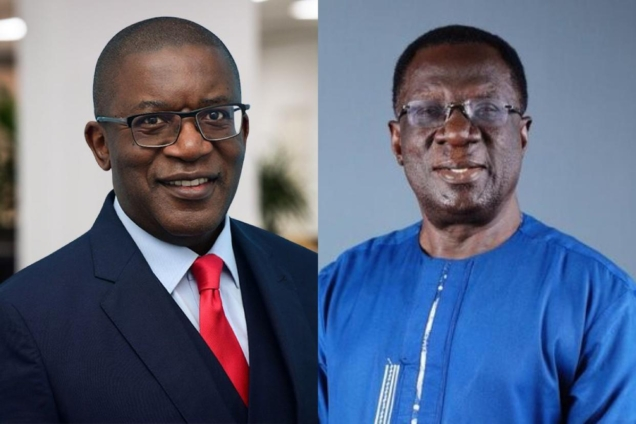
The first prosecution witness in the ongoing Sky Train trial involving former Ghana Infrastructure Investment Fund (GIIF) Chief Executive Officer, Solomon Asamoah, and former Board Chairman, Professor Christopher Ameyaw Akumfi, failed to appear in court on Tuesday, December 16, 2025, prompting an adjournment of proceedings.
State prosecutors informed the High Court that the witness, Yaw Odame-Darkwa, had called to report that he was unwell and unable to attend the hearing.

The court, presided over by Justice Audrey Kokuvie-Tay, granted the request and adjourned the case to Wednesday, January 14, 2026.
Tuesday’s sitting was scheduled to be the fifth day of cross-examination of Mr. Odame-Darkwa by Victoria Barth Esq., counsel for the first accused person, Mr. Solomon Asamoah.
Over the past four sittings, the prosecution witness has faced intense questioning that has exposed multiple inconsistencies between his oral testimony and his written witness statement filed by the Attorney-General.
Contradictions emerge in cross-examination
Cross-examination began on November 10, 2025, when defence counsel accused the witness of failing to pay attention to detail. Among the issues raised was the fact that he had signed his witness statement despite his name being misspelled.
He also told the court that he studied Law and Sociology at Kwame Nkrumah University of Science and Technology (KNUST), a claim the presiding judge corrected, noting that he read Social Sciences.
At the second sitting on November 12, 2025, Mr. Odame-Darkwa stated under oath that the Sky Train project had been discussed at no fewer than eight separate GIIF Board meetings.
This admission directly contradicted his witness statement, which claimed that the project was introduced only once, never substantively discussed, and never approved by the Board or recommended by the Investment Committee.
During cross-examination, Ms. Barth confronted the witness with signed minutes from at least eight Board meetings where the Sky Train project was discussed.
Mr. Odame-Darkwa conceded that the minutes were authentic, effectively admitting the inconsistency between his testimony and his signed statement.
Court orders production of emails
At the third sitting on December 10, 2025, the High Court ordered Mr. Odame-Darkwa to retrieve and produce approximately 16 emails sent to him by Mr. Asamoah during his tenure as a Board member of GIIF.
The order followed confirmation by the witness that he had received the emails, which related to the Sky Train project.
When defence counsel asked him to retrieve the emails directly from his smartphone in court, Mr. Odame-Darkwa declined, citing concerns about artificial intelligence and stating he preferred to access them on his personal computer and internet connection. The court granted him leave to do so and directed him to produce the emails at the next sitting.
Admissions on day four
On Monday, December 15, 2025, the fourth day of cross-examination, Mr. Odame-Darkwa confirmed that the emails were authentic and still in his possession.
He further admitted that aspects of his witness statement were based on his personal recollection rather than official GIIF documents, despite the fact that relevant records had always been available to him.
At the close of proceedings, defence counsel presented him with an additional 17 emails and attachments relating to the Board meeting at which the Sky Train investment was approved, as well as subsequent updates provided to the Board by the CEO.
He was expected to return the following day to confirm or deny their authenticity.
He did not appear.
Background to the case
In 2019, GIIF invested US$2 million for a 10 percent equity stake in Africa Investor Sky Train Consortium Holdings, the developer of Accra’s proposed Sky Train light rail project.
The project was initiated by the Government of Ghana through the Ministry of Railways Development, which selected Africa Investor Group as sponsors.
At the time, Professor Ameyaw-Akumfi chaired the GIIF Board, while Mr. Asamoah served as CEO.
Following the change of government in December 2024, the Attorney-General alleged that the investment was made without Board approval, resulting in a willful financial loss to the state, citing the absence of a completed railway.
The charges do not allege personal benefit or diversion of funds. No officials from the Ministry of Railways Development or the project sponsors have been charged. Only the former GIIF Chairman and CEO are standing trial.
Some state witnesses who were initially charged with causing financial loss to the state have since had those charges dropped after stating they did not approve the project, raising questions about the consistency of the prosecution’s case.
A lawyer familiar with the matter, speaking on condition of anonymity, described the prosecution as “unsupported by the facts” and driven by political considerations rather than evidence.
The case resumes on January 14, 2026.