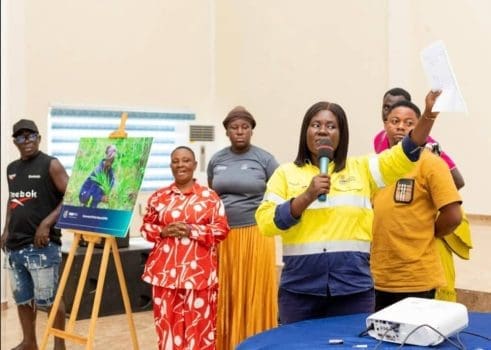
Gold Fields Ghana Foundation has renewed its call for stronger community ownership and protection of water bodies and water systems as it held its Quarter Four Water and Sanitation Review Meeting for 2025.
The meeting, which brought together WATSAN committees from communities across the Tarkwa–Nsuaem and Prestea Huni Valley municipalities, formed part of the Foundation’s effort to advance Sustainable Development Goal 6, which calls for clean water and sanitation for all, and SDG 3, which promotes good health and well-being.


The Project Coordinator for Water, Sanitation and Health explained that the year under review saw a series of capacity-building activities aimed at strengthening community-led management of water and sanitation systems across the organisation’s 22 host communities.
These activities included training area mechanics, undertaking monitoring visits and holding quarterly review sessions to enable communities to assess their performance and plan ahead.
“Together, we assess what has been done and plan how best to run WATSAN activities smoothly and efficiently in the coming year,” she said, noting that the reviews form a critical part of building self-sufficient community management structures.
She highlighted success stories recorded over the year, pointing to improvements confirmed through Foundation monitoring exercises.
“New Atuabo has a success story, with other communities like Amoanda and Koduakrom also doing well. Some have embarked on extensions to underserved areas, while others are drilling additional boreholes to complement existing ones,” she stated.
The Coordinator also commended communities that have demonstrated a strong maintenance culture.
According to her, communities that have kept their standpipes and pipelines in good condition have been supported with sanitation materials to motivate them to sustain the cleanliness and proper upkeep of their water facilities.
However, she expressed concern about what she described as a laissez-faire attitude among a minority of residents who still assume that because Gold Fields funded the water systems, they must be used for free.
She cautioned that such attitudes threaten the sustainability of the systems.
“A few community members still think that because Gold Fields provided the water systems, it must be for free. But maintenance is necessary to make it sustainable, hence the need for communities to take ownership and contribute their token when they use it,” she stressed.
She underscored that true sustainability depends on communities viewing water infrastructure as their own and playing an active role in protecting water bodies, maintaining facilities and ensuring responsible usage.
Without this, she warned, years of investment could erode.
Looking ahead, the Project Coordinator announced that the Foundation is refining its water and sanitation strategy for 2026, with a renewed emphasis on community ownership.
“Once you own the system, there is greater commitment to protect and sustain it into the future,” she said, urging WATSAN teams to consolidate the gains made so far.
The review meeting thus reinforced a central message: for rural and mining host communities to enjoy clean, reliable water and improved sanitation, they must see themselves not merely as beneficiaries but as custodians—protecting their water bodies, maintaining their systems and ensuring future generations inherit sustainable water sources.
From KWAME MALCOLM, Takoradi