President John Dramani Mahama has announced a major scale-up of Ghana’s Household and Backyard Poultry Initiative, revealing that more than 13,000 farmers across 12 districts have so far received 720,000 birds under the Nkokoketenkente Project.
The initiative, one of the government’s flagship programmes for boosting domestic poultry production, is rapidly expanding its national footprint as authorities intensify efforts to cut poultry imports and secure food sovereignty.


Speaking at Ghana’s 41st National Farmers’ Day celebration in Ho in the Volta Region, the President said the project had already extended support to 50,000 farmers nationwide, including 500 medium-scale producers and thousands of households.
He emphasised that strengthening the poultry value chain had become central to the country’s agricultural strategy, noting that a strong domestic poultry industry was critical to reducing foreign exchange losses, creating jobs and feeding the nation sustainably.
To consolidate these gains, President Mahama said the government was collaborating with the private sector to establish modern poultry processing plants across the country.
On 27 November 2025, he broke ground for the first of these plants at Bechem in the Ahafo Region, describing it as a decisive step towards ensuring market access, enhancing value addition, and creating sustainable employment opportunities along the poultry value chain.
He stressed that the plants would help eliminate the recurring bottlenecks of post-production losses and unreliable market outlets that have long discouraged local poultry farmers.
The President also highlighted the role of farmer cooperatives in ensuring the sustainability of interventions like the Nkokoketenkente Project.
He disclosed that more than 70,000 community- and commodity-focused cooperatives, representing about 710,000 farmers, had been registered and integrated into all major agricultural initiatives.
He said this large cooperative network was strengthening farmers’ bargaining power, promoting fair pricing and deepening collective problem-solving across the agricultural sector. According to him, the model was essential to ensuring scalability, coordination and inclusivity.
President Mahama reiterated that feeding Ghana required a renewed commitment to eating Ghana, asserting that the country could no longer afford to import what it readily grows.
He said the government was aggressively promoting local consumption of Ghanaian rice, poultry, yam, fruits and vegetables, cooking oil and cassava products as part of a broader drive to anchor national food sovereignty and improve agricultural profitability.
Achieving this vision, he added, demanded climate-smart approaches, strong risk-management systems and sustained investment in research, innovation and agro-ecological practices.
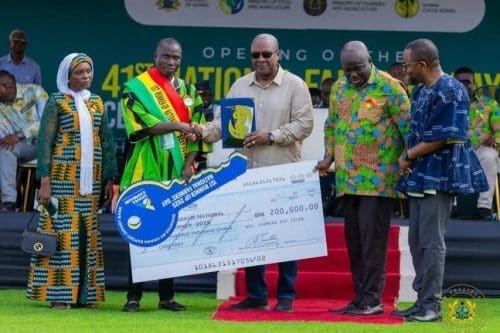
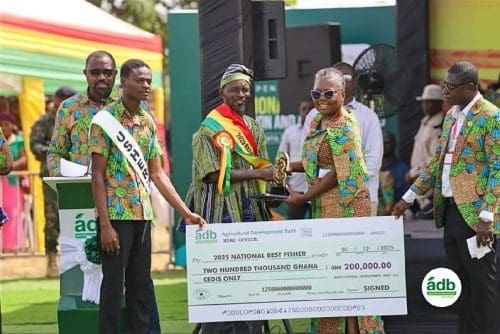
The event, which honoured the nation’s best farmers and fisherfolk, saw Opanin Abraham Kwaku Adusei of Kwahu Afram Plains adjudged the 2025 Overall National Best Farmer.
Forty-eight-year-old Mr Osumanu Kadri of the Greater Accra Region was named First Runner-Up, while 63-year-old Mr Charles Jato from the Oti Region claimed the Second Runner-Up position.
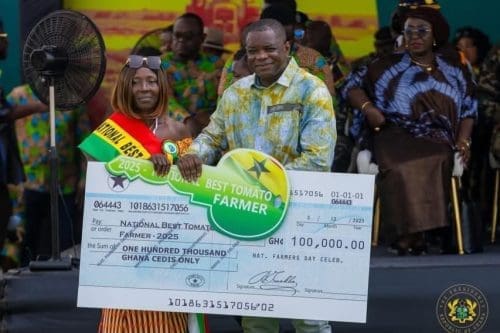
Mr Reuben Asare from the Kintampo North District in the Bono East Region emerged National Best Youth Farmer, and Madam Grace Owusua from the Ashanti Akyem North District won the National Best Female Farmer award.
President Mahama paid glowing tribute to Ghana’s farmers and fisherfolk, describing them as the backbone of the country’s socio-economic progress and “the real heroes of Ghana’s development.”
He encouraged Ghanaians to renew their collective resolve to support local production, invest in agriculture, consume locally produced foods and believe in Ghana.
Securing the nation’s future, he said, required coordinated efforts from government, the private sector, communities and all stakeholders to build a food-secure and resilient country.
He further noted that the government was strengthening collaboration with development partners, financial institutions and private sector actors to make agriculture a viable and attractive livelihood for future generations.
The President expressed gratitude to partners, including IFAD, AGRA, GIZ, KfW, WFP, JICA, FDO, KOICA, AFD, the African Development Bank, the World Bank and the Governments of Italy, Norway, the Netherlands and Canada for their continuous support to Ghana’s agricultural transformation agenda.
He also acknowledged the contributions of the Agricultural Development Bank, Exim Bank, Stanbic Bank, farmers’ unions, researchers and private sector players to the success of this year’s celebration and the country’s agricultural programmes. President Mahama commended the Minister of Food and Agriculture, Mr Eric Opoku, and his team for their commitment and diligence in driving ongoing reforms aimed at revitalising Ghana’s agricultural sector.