
Investigate mass failure of 2025 WASSCE results — Mahama
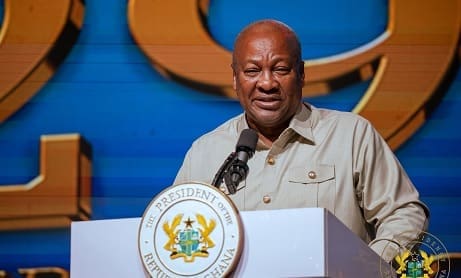
President John Dramani Mahama
President John Dramani Mahama has directed the Ministry of Education and the West African Examinations Council (WAEC) to launch a full-scale investigation into the widespread failure recorded in the 2025 West African Senior School Certificate Examination (WASSCE).
The directive follows growing public concern after thousands of students across the country received unexpectedly low grades, with some schools recording their worst performance in years.
Parents, teachers, and education advocates have questioned the credibility of the results, calling for transparency and accountability.
Mahama described the 2025 WASSCE results as “mind-boggling” and emphasised the need to uncover the root causes.
He noted that the integrity of Ghana’s education system depends on ensuring fairness, accuracy, and reliability in national examinations.
Speaking at the unveiling of the STEMBox initiative for primary schools, Mahama said the poor results have become a major worry for the government, parents, and the general public.
He said “It has become an issue of great concern to the government, parents, and the public at large. I was speaking with the minister, and I have asked them to do an analysis of the examiners’ report and try and decipher what could have gone so disastrously wrong.
“It is mind-boggling that with the same teachers, the same factors in play just from one batch to another, one batch does so disastrously.”
His comments come following the troubling national performance decline in the 2025 WASSCE results.
Earlier, WAEC said it had identified the main reasons for the sharp drop in performance in the 2025 WASSCE, particularly in Core Mathematics and Social Studies.
WAEC’s Head of Public Relations, John Kapi, said the chief examiners’ reports revealed serious skill gaps among candidates.
Core Mathematics suffered the worst results, with A1–C6 passes plunging from 305,132 in 2024 to 209,068 in 2025—a shortfall of more than 96,000. Only 48.73% achieved the required grade for tertiary entry.
Kapi dismissed claims that the exam paper was unusually difficult.
He said the 2025 questions were comparable to the previous year’s, adding that “the weaknesses were largely candidate-related.”
Seven major problem areas were identified: inability to draw or interpret diagrams, difficulty handling global maths problems, poor construction of cumulative frequency tables, weak application of real-life scenarios, challenges with simple interest, difficulty translating word problems, and poor interpretation of cumulative frequency data.
Social Studies examiners also reported major shortcomings in the WASSCE. Many candidates could not articulate government initiatives aimed at improving living standards, explain the impact of lavish funerals on development, or analyse Ghana’s cooperation with UN agencies.
WAEC said it will use these insights to guide targeted interventions in schools. The Council plans to collaborate with the Ministry of Education and other partners to address the underlying issues and improve students’ readiness for upcoming examinations.
However, the Ghana Education Service (GES) has firmly rejected claims that the 2025 West African Senior School Certificate Examination (WASSCE) results were inaccurate or unfair, insisting that the outcomes “credibly reflect students’ academic performance.”
According to the GES, a total of 6,295 candidates had their results cancelled after being found with unauthorised materials, including prepared notes, textbooks and printed sheets, during the examinations.
In addition, 1,066 candidates remain under investigation for alleged examination offences. Of this number, 908 have specific subject results withheld, while 158 have had their entire results withheld pending further inquiry.