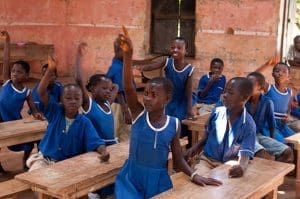
Return mission schools to restore quality education
For decades, calls for mission schools in Ghana to be handed back to their original proprietors, the churches, have been met with mixed reactions. But recent developments, particularly the Wesley Girls’ controversy and the resulting constitutional battles, reveal that this debate is no longer about nostalgia or emotion.
It is now about national identity, discipline, educational efficiency, and long-term peace.
Ghana stands at a crossroads, and the choice it makes will determine not only the moral future of its youth but the stability of the nation’s multicultural and multi-faith coexistence.
The Wesley Girls’ saga reawakened a national conversation that had simmered for decades. Beginning in 2021, the school founded by the Methodist Church was accused of preventing a Muslim student from fasting during Ramadan.
What followed was a heated national debate about whether government-assisted mission schools should enforce rules rooted in Christian tradition.
The Methodist Church defended its policy, explaining that the “no fasting” rule had existed for health and disciplinary reasons, applied to all students equally, and was part of the school’s long-standing Christian upbringing.
But critics argued that because the government supports these schools financially, they must accommodate all religious expressions, even if this undermines the original Christian mission.
After years of rising tension, the matter reached the Supreme Court in 2024, where private legal practitioner Shafic Osman challenged the school’s policies as unconstitutional.
The Court’s pending ruling will set a historic precedent: whether mission schools may maintain their religious identity or be stripped of the values and principles that made them successful in the first place.
More importantly, the case has exposed a troubling reality: Ghana has drifted into a place of religious confusion, where the identity of institutions has been blurred by an unclear partnership between the State and the Church.
But the churches have made their position unmistakably clear. In November 2025, the Ghana Catholic Bishops’ Conference and the Christian Council of Ghana issued a joint statement defending their foundational rights.
They reminded the nation that mission schools were not built by the government; the churches purchased the land, built the facilities, trained the teachers, and crafted the moral and academic ethos long before Ghana became a state.
Government funding, they stressed, is a partnership, not a takeover.
The State supports them because it recognises the value of these institutions, not because it owns them.
To force mission schools to dilute their Christian identity would violate their religious freedom and their constitutional right to operate according to their faith.
This argument is not only legal it is practical. Ghana’s growing indiscipline crisis did not emerge overnight.
Many clergy, particularly in the Eastern Region, have noted that discipline began to decline when government took over the mission schools.
Churches are known for tight supervision, consistent maintenance, strong moral training, and community accountability.
Government schools, on the other hand, often wait years for repairs and struggle with administrative inefficiencies.
If the goal is to restore discipline in Ghana’s youth a goal every parent desperately desires then putting mission schools back into the hands of the churches is a proven solution.
Critics argue that handing back the schools may lead to high fees and religious discrimination. But this, too, has a ready solution one demonstrated successfully by Canada.
In Ontario alone, there are 37 publicly funded Catholic school boards operating more than 1,500 schools that educate over 550,000 students.
These schools are proudly Catholic in identity but fully funded by the Canadian government.
The government collaborates with Catholic, public, French, and English boards, ensuring fairness while respecting religious identity.
In total, Ontario runs over 4,800 government-funded schools, with Catholic schools receiving the same support as public ones.
The result? Zero religious conflict, national peace, and high educational standards.
Ghana can adopt this balanced model. The government can fund infrastructure, salaries, and curriculum, while the churches maintain managerial control, discipline structures, and their religious ethos.
Parents would remain free to choose public schools for a secular environment, or mission schools for a faith-based upbringing.
This model preserves religious freedom, strengthens partnership, and shields the nation from future interfaith tensions.
The churches cannot and should not be forced to dissolve their Christian identity simply because non-Christian parents voluntarily choose to send their children there.
Freedom of choice cuts both ways: if parents have the right to choose a school, the school has the right to maintain its character.
What Ghana must seek is harmony, not homogeneity; partnership, not pressure.
Returning mission schools to the churches is not the rejection of diversity rather, it is the protection of institutional identity and the preservation of peace.
It is the path to restoring discipline, strengthening our education system, and relieving the government of a burden it can no longer carry alone.
It is the way to ensure that Ghana’s future leaders are shaped not only academically, but morally and spiritually values the nation desperately needs in this era of rising indiscipline and moral uncertainty.
The time has come for Ghana to take a bold step rooted in history, law, and common sense.
The mission schools must return to the missions not to divide Ghana, but to rebuild it.
From Stephen Armah Quaye